
The co-chair of the Party for a Free Life in Kurdistan (PJAK), Amir Karimi, stated that in light of the US–Israeli war against Iran, his movement is ready to defend the Kurdish population. In an interview with Stêrk TV, Karimi emphasized that PJAK has a strong social base in Rojhilat and is organizationally prepared for possible developments.
At the beginning of the interview, Karimi commemorated Kurdish politician Salih Muslim, a member of the Presidential Council of the PYD, who recently passed away after a long illness. Muslim, Karimi said, was a defining figure of the Kurdish freedom movement. He dedicated his life to the political struggle for the rights of the Kurdish people and became a symbol of this commitment for many, he added.
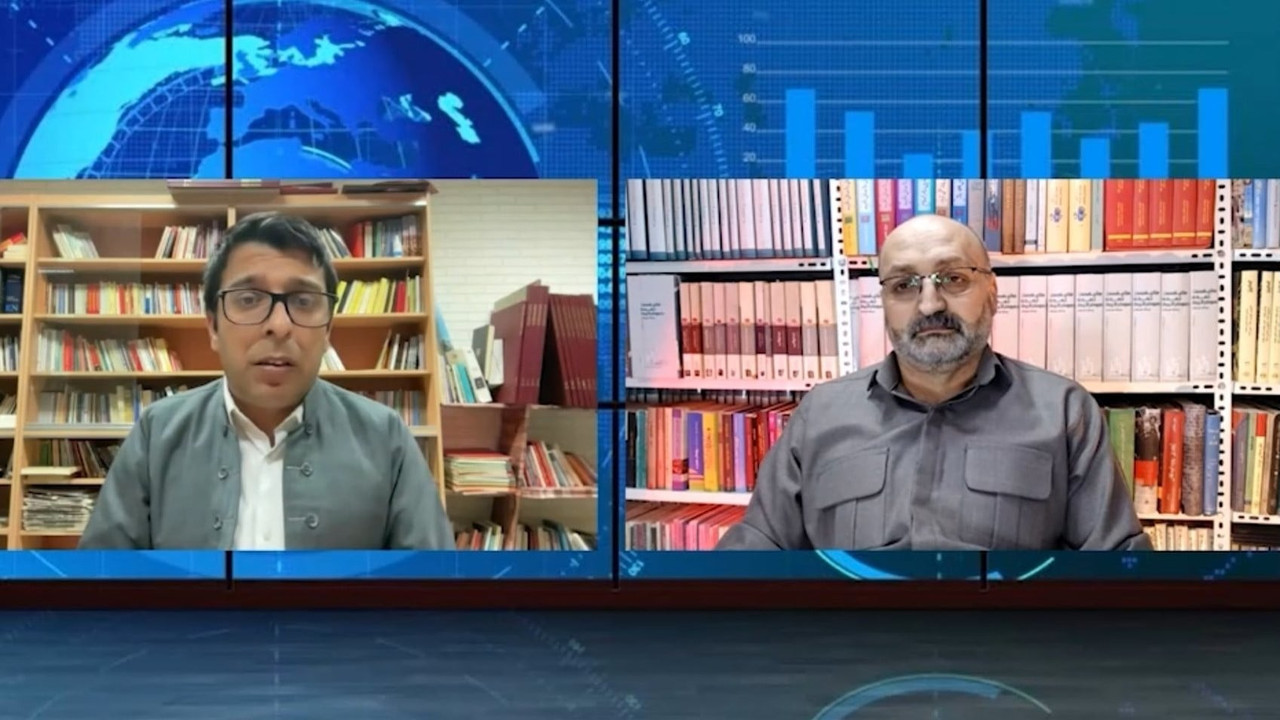
PJAK sees itself prepared for possible developments
Referring to the attacks by the United States and Israel on Iranian territory that have continued for weeks, Karimi stated that PJAK is a strong movement and sees itself as part of society in Rojhilat. “Many young people are active within its ranks, fighting for freedom and the rights of the Kurdish population. In more than two decades of political activity, we have shown that we are ready to make great sacrifices for the freedom of the people. The movement is also prepared in the current situation. As PJAK, we are ready to do everything necessary to protect our people,” Karimi said. However, he emphasized that the defense of the population must be based on social organization and collective self-defense.
Denial of reports about border movements
Karimi also rejected reports in international media claiming that Kurdish parties were transferring their forces from South Kurdistan across the border into Rojhilat (East Kurdistan). Such portrayals do not correspond to reality but are part of propaganda, the PJAK co-chair said. “These reports are not true. Moreover, such an approach would also be strategically wrong.” He said it was unclear according to what logic reports were being spread claiming that all forces would first wait at the border and then collectively cross to the other side. “We cannot understand what is intended with such portrayals,” Karimi said.
According to him, no such movement has taken place. For PJAK, there is also no reason to stage such a scenario. “We are already in Rojhilat, that is, inside Iran. Therefore, we do not need to claim that our forces are waiting at the border or have crossed it.” Karimi stated that the organization has prepared and operational structures inside Iran. “These forces are in close contact with the people, which is widely known. Reports by some media about alleged border crossings therefore have no basis and do not concern PJAK.” He also said he had not observed any such movement among other Kurdish parties. “There are absolutely no signs that would confirm such claims,” Karimi stated.
No talks with the United States
The PJAK co-chair also commented on recent statements by US President Donald Trump about the Kurdish people. He clarified that there have been no talks between his party and the United States. At the same time, Karimi rejected reports claiming that Washington is holding talks with Kurdish political parties. “Such claims do not correspond to reality. Trump has not contacted any Kurdish political party,” Karimi said. He added that no clear political line of the United States toward the Kurdish people can be seen. “So far, we see no strategy from Washington regarding the rights of the Kurdish population, their political status, or their territories. We still do not see a US policy regarding us.”
Political alliance of Kurdish parties
Amir Karimi also addressed the alliance recently formed by six Kurdish political parties in Rojhilat. He emphasized: “It is not a military alliance but a political one. At the same time, it is a very important and historic alliance. PJAK attaches great importance to this formation. It is not merely a tactical gathering or an occasional exchange of views. Rather, the goal is to place this alliance on a democratic foundation. Regardless of different political positions, the Kurdish people must be able to act together on a democratic basis.”
Karimi explained that the aim is to defend common interests together while also creating space to discuss differing positions. “Each party has its own political ideology and will continue to represent it. What matters is that these differences can be discussed within a democratic framework. To understand one another, we must take this path,” Karimi said. “The goal is to develop a democratic form of political struggle. This does not mean that criticism among the parties is excluded. Rather, the alliance aims to create a democratic political climate and to accept different positions.”
Talks on cooperation in the military field
Karimi noted that the alliance was created in the interest of the Kurdish population and thanked all the parties that participated, describing their stance as positive. At the same time, he called on other parties that have not yet joined to become part of the alliance. The alliance, he said, should not be limited to political parties alone. “Civil society forces should also be included. The aim is to create a political force that represents society as a whole and contributes to developing a common political language among the Kurds.”
Karimi also pointed out that there are efforts to establish a similar form of cooperation in the military field alongside the political alliance of Kurdish parties. “There are initiatives in this direction, but no results have yet been achieved. However, we hope that a joint military force can also emerge. Such a structure, however, should not be tied to a single party. Military forces should fundamentally not be under the control of political parties.”
“The parties should focus on politics and diplomacy,” Karimi emphasized. He remarked that the alliance of Kurdish parties in Rojhilat must lay the foundation for a free country, a free people, and a society that governs itself. “Political parties should continue their work within such a system. Military structures and security forces, on the other hand, must be accountable to society itself. In principle, all parties agree on this issue,” Karimi said, while acknowledging that implementation will take time.
Call for Kurdish national unity
Karimi also stressed the importance of Kurdish national unity. In addition to political unity among Kurdish forces in Rojhilat, unity among the Kurdish people in all four parts of Kurdistan must also be strengthened, he noted. “This unity is especially important for Rojhilat. Fragmentation harms us. We have repeatedly experienced its negative consequences in the past.” The population in Rojhilat, he said, is a courageous people who have made great sacrifices and deserve freedom. “All Kurdish political parties must act with this sense of responsibility. The political steps taken today must honor those who have fallen.”
“Precisely for this reason, unity is of central importance,” Karimi stressed. He noted that a rational common approach has now emerged that allows the parties to better understand and accept one another. “Through the alliance of Kurdish parties, it has become possible to reach all of Rojhilat. In the past, individual parties were often limited to certain regions. With the new alliance, all forces can now be present in all parts of the region. As PJAK, we are present everywhere—from Urmia to Kermanshah and Ilam, and into the Zagros Mountains,” Karimi said. He also called on all Kurdish parties to become active in these areas, carry out political work, and represent their positions within society.
Differences must belong to the past
“The time when Kurdish parties were played against each other because of small differences must belong to the past. Different political approaches are not a weakness but a richness,” Karimi continued. He also emphasized that the Kurdish people could serve as a political example for all of Iran. “Society is deeply divided, and many groups are discussing different future scenarios. In this situation, the Kurdish people could play a leading role in developing a democratic political model. The Kurdish people can play a leading role for a democratic future in Iran. Kurdish politics must therefore expand in order to contribute to democratic transformation,” he underlined.
At the same time, he stressed that while Kurdish parties conduct their own diplomacy and political activities, it is crucial that the Kurdish people formulate their fundamental demands together. “We must place the voice and the will of our people at the center. If Kurdish parties fail to do this, the people will not forgive them. We do not have the right to squander the sacrifices of the young people who have resisted for years in the streets and in the mountains and who have shed their blood for this struggle. For our people, we must succeed—and we will succeed.”
Kurds are a symbol of hope for democracy
Karimi also stated that the alliance of Kurdish political parties has received strong support among the population. The alliance, he said, has created joy among the people and is perceived as a source of hope not only by Kurds but also by other oppressed communities. “This alliance is not only a source of joy and hope for our people but for all oppressed peoples,” Karimi said and added that many people see in it the message that common alliances are possible and can also succeed.
Karimi noted that PJAK maintains contact with various religious communities and social groups. These groups, he said, are also beginning to form their own alliances, and such coalitions are important to discuss how a democratic Iran can be built. Karimi also emphasized that relations between the Kurdish people and other communities in Iran are generally good. Especially after the “Jin, Jiyan, Azadî” (Woman, Life, Freedom) uprising, the Kurdish people have become a symbol of hope for democracy for many.
Appeal for social self-organization
In conclusion, Amir Karimi addressed the Kurdish people directly. The goal, he said, is to build a democratic society that does not accept oppression and injustice and is based on equality and justice. “We want to create a democratic society,” he said. “This means a society in which women are free, that lives in harmony with nature, and where people can resolve their own problems. Such a society must be able to resist all forms of coercion and oppression.”
The PJAK co-chair continued: “The population must increasingly organize its own affairs. State institutions have neither in the past nor today contributed to resolving the people’s problems. Kurdistan has been systematically excluded from fundamental resources and services. The Kurdish people must show that they do not need state institutions. The Iranian state carried out a massacre against the population only two months ago. If such attacks occur again, the population has the right to defend itself.”
ISIS presence in Rojhilat
Attacks on society do not occur only with weapons, Karimi said. There are numerous forms of pressure and attacks against the people. “The moral and social structures of society are also under attack. Therefore, institutions are needed to protect society.” Karimi also warned about the presence of ISIS in Rojhilat, which, he said, poses a threat to the existence of the Kurdish population. People must remain vigilant on this issue, he warned.
At the same time, he referred to the severe economic crisis in Iran and pointed out that people must support each other. “Many injured and sick individuals receive no adequate medical care. Hospitals often refuse to treat Kurds, and people seeking medical assistance are sometimes arrested. The population faces many problems.”
Karimi called for the development of social mechanisms to resolve conflicts and problems independently, without relying on state institutions.
“No one should believe that forces from outside will come and save us”
Karimi also warned against the illusion that external powers could liberate the Kurdish population. “No one should believe that forces from outside will come and save us,” he said. “International actors act according to their own interests and have themselves stated that they did not come to bring democracy. The Kurdish people must therefore act in their own interests. Freedom can only be achieved through the strength of society itself. We must believe in our own strength. We have experience,” Karimi said. He called especially on young people and women to organize themselves and build social structures, noting that PJAK stands ready to contribute.
At the same time, Karimi emphasized that the goal is not to seize territories and establish a separate power structure there. Such an approach would not bring a solution, he added. “What matters is that power lies with the people themselves and that structures are created to enable social self-administration. There are various developments and interventions, but the decisive factor is the people,” Karimi concluded. “We are not a force outside society.”
Leave a Reply