
The 1960s were a whirlwind worldwide. They were wonderful times, of which we remember the revolutionary events more vividly than the violence and violations of the system. How can we forget the days of resistance and combat by the people of Vietnam and their tremendous “Tet Offensive” in 1968, which was a tremendous strategic victory and a defeat for the United States, the world’s leading military power, which thus began its inevitable withdrawal from Southeast Asia.
How can we not feel proud of the Black Panther Party in the United States, of the Latin American guerrilla movements born in the heat of the Cuban revolution, of the struggles of European workers and students, of the revolutions and independence movements in Algeria, Vietnam, Angola, Mozambique, and so on, until we complete an enormous tapestry of popular struggles and resistance movements around the world.
In that world on the move, Che’s death was received in two ways: as a blow due to the loss of someone we had held in the highest esteem; and as an example of life, of consistency between what he said and what he did. Over time, the pain dissipated and what remained, undefeated, was the image of the heroic guerrilla, that remarkable character who had made his rebellious will the best legacy for the generations that came afterwards.
More than his ideas, which I share, I have always been interested in his letters, especially his “farewell letters,” as he wrote several of them because he often found himself in dangerous and uncertain situations. My favorite is the one he wrote to his parents in March 1965, which begins with a reference to Don Quixote: “Once again I feel Rocinante’s ribs under my heels, and I return to the road with my shield on my arm.”
It is a letter full of affection but also self-critical, despite its brevity, barely a page long. “Many will call me adventurous, and I am, but of a different kind, one of those who put their lives on the line to prove their truths.” He was never afraid to call a spade a spade, because he was one of those genuine people who do not hide behind ideological masks. He even admits to being “extremely rigid” when it comes to expressing his feelings, something that resonates with those of us who began our mlitancy in the late 1960s.
One of the most beautiful phrases, because it forces us to look at ourselves, is the one that refers to the revolutionary’s willpower, that characteristic that allows him to overcome his own limitations and the most adverse situations. “A will that I have polished with an artist’s delight will sustain flaccid legs and tired lungs.” Here he also reveals himself as a refined writer, capable of synthesizing deep feelings with elegance and even humor in just a few words.
The legacy Che left us was, above all, ethical. “Be like Che,” the phrase that said it all, was much more than respect for the revolutionary icon of the moment. It was a promise of life, of giving one’s life if necessary, for the revolution that would bring happiness and well-being to the world. We repeated “be like Che” like a mantra in the face of any difficulty, and even out of habit. That’s how deeply rooted was the feeling of fighting the enemy with weapons in hand. Of putting our bodies on the line and risking our lives for pure conscience and consistency.
Decades have passed—six, to be exact—and armed struggle, as Che understood it, is no longer the option of emancipatory movements, at least in Latin America. However, the reference to Che as an example of life remains important, showing that the issue was not reduced to taking up arms but to something much deeper and more lasting: something like a revolutionary spirituality, an ethic of life, something immaterial that contrasted with the cold materialism we inherited from the Bolshevik revolution.
Regarding his limitations, there is a confession that I believe is also an important legacy. “I haven’t known how to express my love,” he tells his parents, after assuring them that he loves them. And I am convinced that this is also a significant legacy of Che, because it reminds us that revolutionary militancy has often been too rational, rigid, ideological, but lacking in love.
I would like to devote some space to this topic, which I believe is highly relevant today. For Lenin, for whom I continue to admire, a militant had to be a self-sacrificing, tough, and intransigent person. Nikolai Ostrovsky’s novel “How the Steel Was Tempered” is a good example of this type of person, clearly of Stalinist influence. This type of militant was inspired by Nikolai Chernyshevsky’s novel “What Is to Be Done?”, published in 1863, a work admired by Lenin and the narodniks to which its author belonged.
However, a century after the Bolshevik Revolution and 60 years after Che’s death, we must recognize his heroism, without a doubt, but also take Guevara’s confession to his parents as a limitation to be overcome. You are not more revolutionary for walking around with a frown on your face, for not allowing yourself to smile and show affection to your colleagues, friends, and family.
I don’t know anyone who has joined the struggle because they read Marx, or Lenin, or any other author. Real people do it out of indignation, out of rejection of the oppressor, as a radical reaction to the situation we are living in. Thought comes later. It is a way of better understanding the reality we want to transform, or of understanding the oppression and humiliation that each of us suffers, both individually and collectively.
José María Arguedas, one of the greatest Latin American writers, coined a remarkable phrase: “Socialism did not kill the magic in me.” Born in the Andes, a lover of Quechua culture, enamored with its music, songs, and dances, he had a fleeting relationship with the Peruvian Community Party because he did not accept what he considered a “backward” culture. To think that socialism can be reduced to a science, as Abdullah Öcalan pointed out, is to strip it of its human character, that is, the main aspect of this movement. The Kurdish revolutionary wrote: “To deprive thought of utopias and mythologies, of legends and epics, is like leaving the body without water.”
In his economic management as Minister of Industry in Cuba, he decided that workers should self-manage their working hours, something that went against all productive rationality since they could come in at whatever time they decided and leave when they needed to. It was a productive failure, but at the same time, it showed the enormous trust that Che had in people. The whole debate about “moral incentives” rather than material ones is summed up in a famous phrase: “Socialism without communist morality does not interest me. We are fighting against poverty, but at the same time against alienation.”
For Che, voluntary work was the antithesis of the material incentives implemented in the Soviet Union, which he saw as closely linked to capitalism. He considered revolution to be a profound change in social relations and not an exponential increase in production. “In our position, communism is a phenomenon of consciousness and not just a phenomenon of production; and communism cannot be achieved by the simple mechanical accumulation of quantities of products made available to the people.”
He took a stand against economism and the simple development of productive forces as the key to overcoming capitalism. His thinking was based on a break with orthodoxy and Soviet manuals. He was a Marxist committed to communism as a political and moral project, placing ethics at the helm of the revolutionary process and always promoting the confrontation of dogmatic vices, themes elaborated in Critical Notes on Political Economy, where he makes a frontal critique of the Soviet model.
Che’s ideas and life are an endless source of learning that we have not yet explored in all its dimensions. As with all great figures in history, Che has many sides to him, contradictory ones indeed, but I believe that in these difficult times for humanity, we should revisit his more utopian and hopeful aspects.
Source: Yeni Özgür Politika
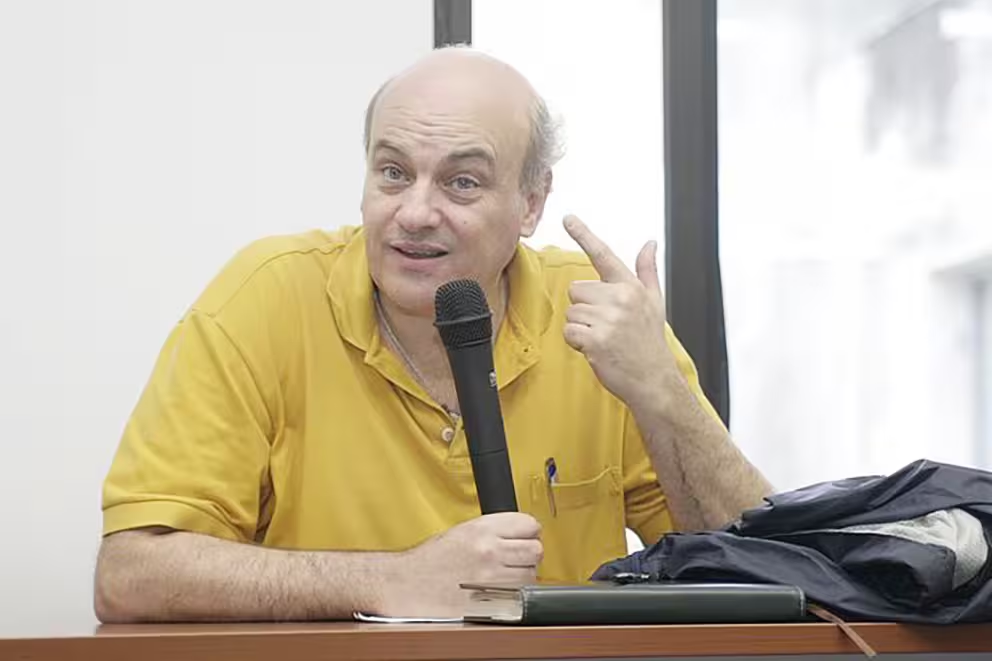 Raúl Zibechi