
Constitutional lawyer and politician Mithat Sancar has spoken out in favor of developing a multidimensional “law of peace” as the basis for lasting political dialogue in Turkey. At a workshop held by the DEM Party in Ankara on Saturday, Sancar emphasized the need for legal regulations to secure the ongoing process toward democratic coexistence and make it socially credible.
Members of the DEM Party’s “Commission for National Solidarity, Fraternity, and Democracy” established in the Turkish Parliament, as well as lawyers, politicians, and academics, participated in the event entitled “Legal Requirements in the Process for Peace and a Democratic Society.”
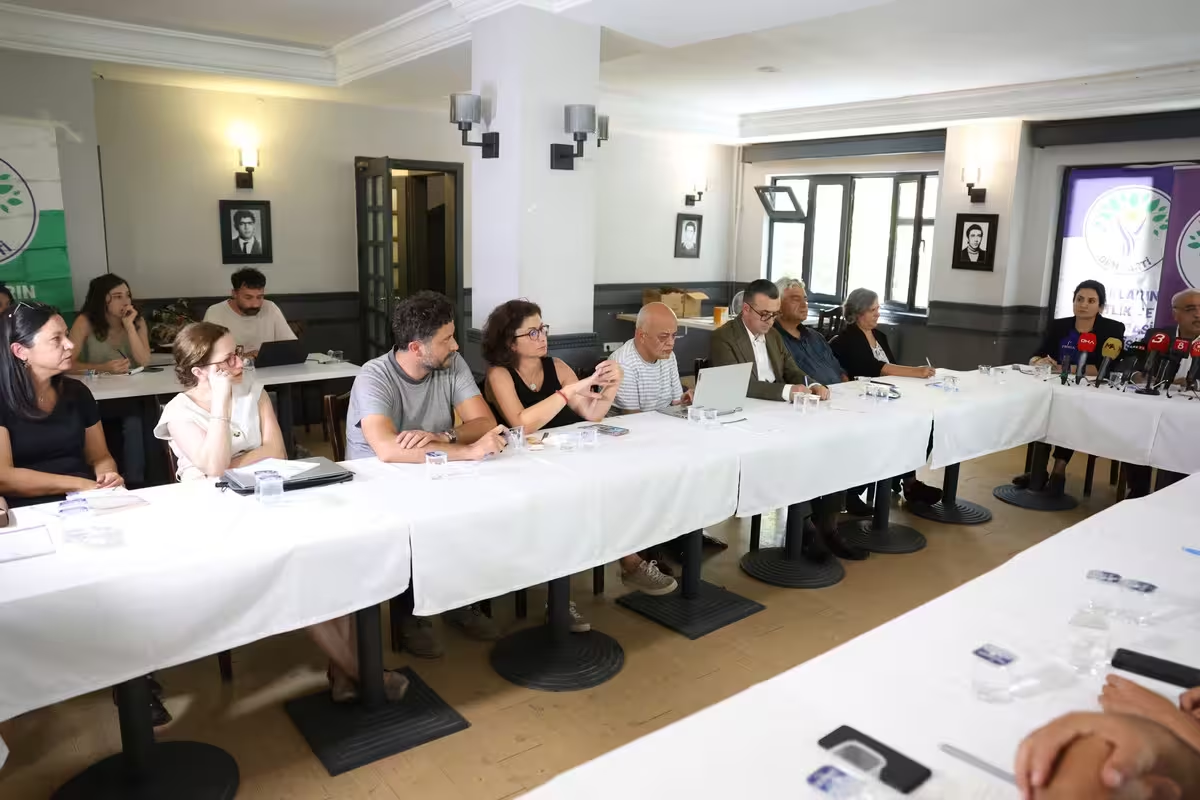
Sancar, who is a member of parliament for the DEM party and a member of the Imrali delegation, gave the opening speech. He recalled recent developments in connection with the new social dialogue process, the first signals of which had been received in October, including a much-noticed speech by MHP leader Devlet Bahçeli referring to Abdullah Öcalan. In this context, Öcalan’s video message published in July and the symbolic burning of weapons by a 30-strong PKK group near Sulaymaniyah in South Kurdistan were also significant, Sancar noted.
Peace requires a legal basis
According to Sancar, one thing is certain: a sustainable peace process can only be built on a clear legal foundation. He divided the “law of peace” he is calling for into three dimensions:
1. Ending violence: The first step is to legally end the armed conflict. This requires political measures as well as legal regulations that replace violence with political participation. “When the violence ends, democratic politics must take its place,” said Sancar. The previous equation of violence and repression must be replaced by a relationship between conflict resolution and democratic participation, he said.
2. Identifying and addressing the causes of conflict: The second component is the legal and political examination of the causes of the conflict. “We call it openly: it is the Kurdish question,” said Sancar. Without analyzing the structural causes and initiating appropriate reforms, lasting peace is not possible, he said, and therefore called for far-reaching legal measures that specifically address discrimination, representation, and equal rights.
3. Democratic restructuring and institutional safeguards: The third pillar is the long-term democratic transformation of society. This includes legal reforms, institutional changes, and the creation of legal guarantees for all parties involved. “Trust is based on guarantees—not promises,” emphasized Sancar and remarked that social trust cannot develop without reliable structures.
Democratic integration as the key
Another central topic was the question of how former PKK fighters can be integrated into civilian life. Sancar spoke of “democratic integration,” a term that is also used in UN documents. This integration, he said, must be considered in two dimensions: in the short term in terms of political participation and in the long term as comprehensive democratization in which individual rights—such as identity and equal citizenship—are secured.
“When armed people lay down their weapons, what will happen to their political and social rights?” asked Sancar. The answer, he said, lies in a legally anchored, inclusive transformation process that creates opportunities rather than producing new forms of exclusion.
Parliament and government bear responsibility
Sancar repeatedly emphasized the special responsibility of the government, particularly because of its institutional power and ability to exert control. “Parliament must fulfill its role as the heart of the process. At the same time, it is important to involve civil society. Only in this way can a broad social consensus be achieved and a genuine peace plan be drafted,” he stated.
At the end of his speech, Sancar emphasized that, despite the difficult political situation, there was still room for the rule of law and democracy. “We are often asked whether it makes sense to discuss the rule of law and peace in an authoritarian climate. But it is precisely then that it is necessary to stand up for justice, peace, and democracy.”
After Sancar’s speech, the workshop continued closed to the press. Topics discussed included the legal basis for disarmament and integration, the elimination of discrimination in the prison system, the legal enshrinement of the “right to hope,” reforms in criminal procedure law after the end of the conflict, the expansion of freedom of expression, and the implementation of judgments by the European Court of Human Rights (ECHR) and the Turkish Constitutional Court.