
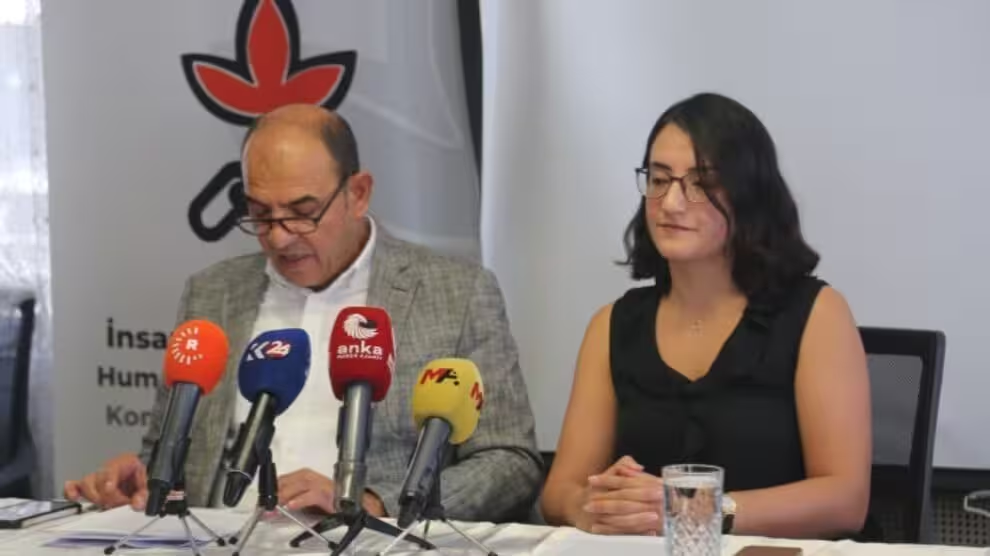
Hüseyin Küçükbalaban, Co-chair of the Human Rights Association (IHD), spoke at a press conference in Ankara and emphasized that the deadlock in the Kurdish question is the greatest obstacle to democracy.
Küçükbalaban noted that the developments following Abdullah Öcalan’s call on February 27 are critical for resolving the Kurdish question on political and legal grounds. He stated that the disarmament process cannot be viewed solely through the lens of security, but requires political and legal transformation.
He also highlighted the need for restorative transitional justice aimed at confronting the past, rebuilding social trust, and reducing the trauma of conflict on individuals, underlining its importance for the socialization of peace.
Küçükbalaban said, “For this process we define as transitional justice, it is of great importance to establish the necessary mechanisms, so that the process can evolve into a lasting peace, and this is as significant as the negotiations between the conflicting parties.”
Recommendations
Ekin Yeter Moray, Co-chair of the Association of Lawyers for Freedom (ÖHD), shared their proposals prepared to contribute to the advancement of the process:
“* An approach must be adopted in which not only the conflicting parties but the whole of society is included in the process; decision-making mechanisms must ensure broad participation, and must be pluralistic, transparent, and open to public oversight.
* The communication rights of Abdullah Öcalan, the imprisoned leader of the Kurdistan Workers’ Party (PKK) who remains under severe isolation in Imralı Prison, must be guaranteed in a way that enables his active participation in negotiations, and his conditions must be brought into line with international law.
* A new social contract and a new founding constitution must be drafted through methods based on broad social participation, paving the way for Turkey’s democratic transformation and securing lasting peace. This must constitutionally guarantee equal citizenship rights, especially the Kurdish people’s demands for mother tongue and cultural recognition.
* The undemocratic Anti-Terror Law must be abolished, and legal reforms in line with the principle of the rule of law and international human rights norms must be implemented.
* Discriminatory execution of sentences imposed on political prisoners, particularly gravely ill detainees, must be ended, and immediate legal amendments regarding the right to hope must be introduced.
* Elected politicians held in prisons must be released immediately, and dismissed mayors must be reinstated to their positions without delay.
* Turkey’s reservations to international conventions that hinder a democratic and peaceful resolution of the Kurdish question, such as the European Charter of Local Self-Government, the International Covenant on Civil and Political Rights, and the Convention on the Rights of the Child, must be lifted.
* Turkey must become a party to treaties that will strengthen human rights, such as the International Convention for the Protection of All Persons from Enforced Disappearance, the Rome Statute of the International Criminal Court, and the Istanbul Convention.
* The rulings of the European Court of Human Rights (ECtHR) and the Constitutional Court must be implemented without delay.
* Obstacles to the participation of disarmed militants in civilian politics and democratic life must be removed.”
Observation report
The observation report on the weapon burning ceremony included the following details:
“* The ceremony began at 11:23 a.m. Turkish time, with a delay of 23 minutes from the scheduled start. It was later learned that the delay was due to changes regarding the location where the weapons inventory and the militants’ identity information would be handed over to civil society organizations.
* The ceremony started with the arrival of a group of 30 militants, consisting of 15 women and 15 men carrying various weapons, approaching from Casene Cave, led by Co-chair of the Kurdistan Communities Union (KCK) Besê Hozat (Hülya Oran).
* The group headed directly to a pre-prepared platform, where a photograph of Abdullah Öcalan taken in Imralı Prison, previously shared with the press, was projected on the wall behind the platform.
* After the group took their places on the platform, Besê Hozat (Hülya Oran) and Behzat Çarçel (Nedim Seven) read statements in both Turkish and Kurdish to the press and the public. At the same time, copies of both versions were distributed to participants.
* When the statement concluded, the 30 militants, beginning with Besê Hozat, placed their weapons one by one into the pit. Representatives of the two institutions designated to receive the militants’ identity information and the inventory of the destroyed weapons, Hüseyin Küçükbalaban, Co-chair of the IHD, Ekin Yeter Moray, Co-chair of the ÖHD, and Coşkun Üsterci, General Secretary of the Human Rights Foundation of Turkey (TİHV), were invited to the ceremony, informed of the process, and then moved to the area reserved for them.
* One militant, later identified as Tekin Muş (Mehmet Demirer), after placing his weapon into the pit, approached the area where the representatives of IHD, ÖHD, and TİHV were present and handed over a file containing the identity information of the militants who had laid down their arms and the inventory of the weapons to be destroyed. On this occasion, he declared: ‘We want violence to be removed from the resolution of the Kurdish question. For this reason, we have symbolically burned the weapons here. From now on, we attach importance to civil society organizations playing a greater role in the resolution of the Kurdish question, and for that reason, we considered it appropriate to hand this file to civil society organizations.’
* After all the militants placed their weapons into the pit, Besê Hozat and Behzat Çarçel approached the pit and, with the help of staff, ignited the weapons.
* Following the burning of the weapons, the 30-member militant group left the site unarmed, returning in the direction of Casene Cave.
* The ceremony concluded around 12:00 noon. In conversations held with journalists, representatives of non-governmental organizations, intellectuals, and politicians present at the site, there was a shared view that the symbolic burning of weapons represented a critical threshold for the democratic and peaceful resolution of the Kurdish question.
* After the ceremony, on July 11, 2025, the observation delegation first returned to Erbil and then departed by bus for Diyarbakır. On the morning of July 12, 2025, at around 6:00 a.m., delegation members arrived in Diyarbakır and then returned to their respective provinces.”