
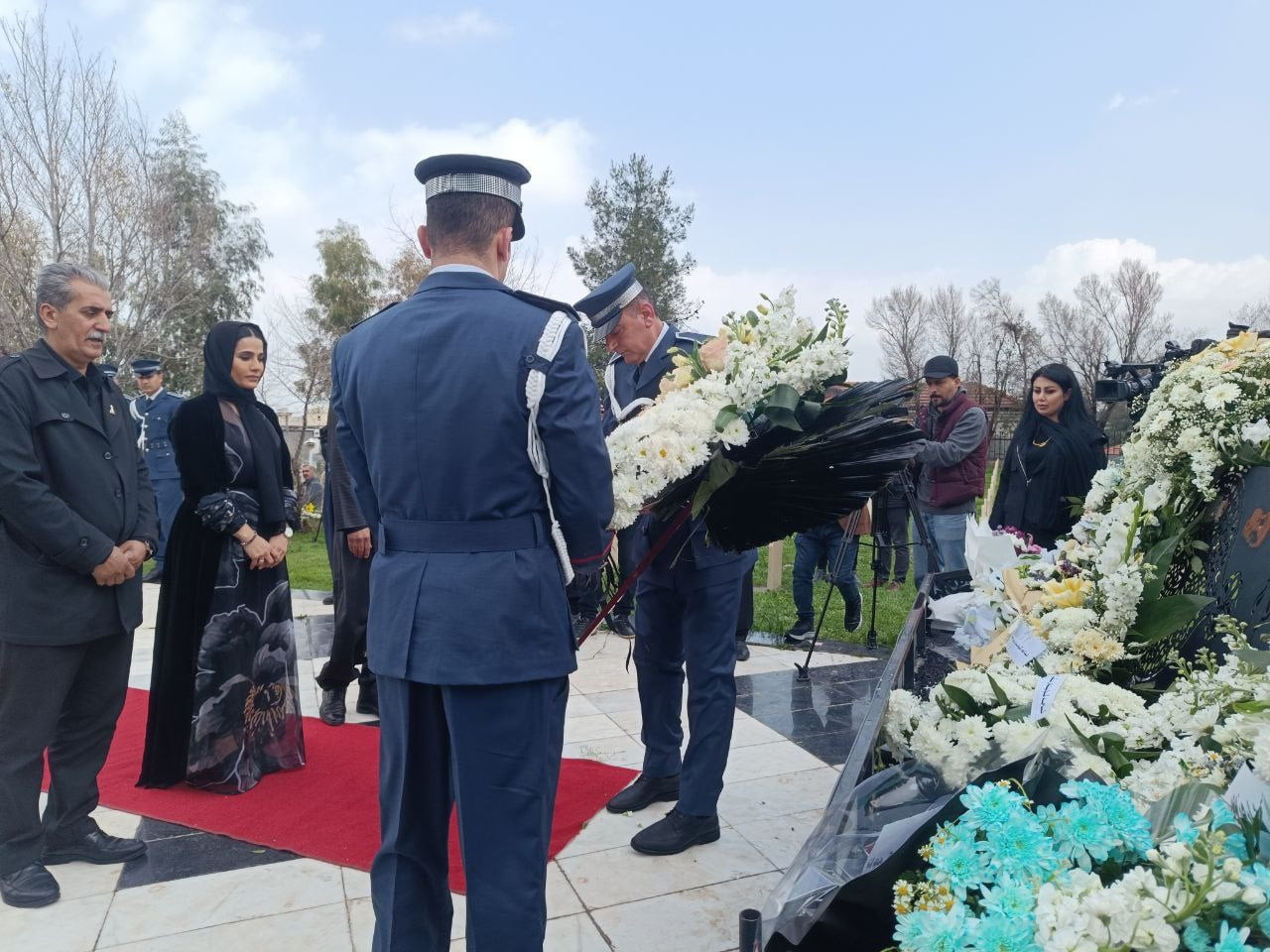
In Halabja, the victims of the chemical attack of March 16, 1988 were commemorated. Due to the US-Israeli war against Iran, public ceremonies this year were held exclusively at the martyrs’ cemetery in Halabja. To honor the 5,000 victims of the genocide carried out by Saddam’s Iraqi regime, Governor Nuxşe Nasîh laid a black wreath at the memorial site.
After the ceremony, Nasîh spoke to the press. She emphasized that Halabja is a city that played a decisive role in making the fate of the Kurds known worldwide. At the same time, she criticized that the support provided by the Kurdistan Regional Government does not meet the expectations of the victims’ families.
Nasîh stated that she would continue working to meet the demands of the families of the victims as well as the people of Halabja. Among her demands is that the parliament and government of the Kurdistan Region of Iraq should in the future hold their first sessions in Halabja, so that the problems of the local population and the families of the victims can be addressed more directly.
The governor also criticized that, despite repeated demands in recent years, the government has not given the city sufficient attention. “Another central issue is the medical care of survivors of the chemical weapons attack. Although the government decided to send some victims abroad for treatment, this is not sufficient. Many survivors require long-term medical care, regular examinations, and continuous access to medication,” she stated.
“The fate of the children who disappeared during the massacre also remains unresolved,” Nasîh said. In this context, she called on the new government of the Kurdistan Region to conduct more intensive investigations and take concrete steps to address this issue. She also expressed strong criticism of the work of the Martyrs Ministry and the Ministry of Health. Both institutions, she said, have failed to provide the necessary support to the families of the victims and the survivors of the massacre. The governor called on the responsible authorities to pay greater attention in the future to Halabja and the needs of the victims’ families.
Chemical attack on Halabja
On March 16 and 17, 1988, the Iraqi air force bombed Halabja in southern Kurdistan (northern Iraq) with chemical weapons. At least 5,000 people died within a few hours, and another 10,000 were injured. This attack was also made possible by European companies that had participated in building Iraq’s chemical weapons production. The attack on Halabja was part of the so-called “Anfal campaign,” a systematic genocide against the Kurdish population in the final phase of the First Gulf War. During this period, around 182,000 Kurds and members of other minorities were killed, thousands of villages were destroyed, and hundreds of thousands of people were displaced.
Leave a Reply